Hormesis 101: Why Hormetic Stress Is Good For You

Hormetic Stree

The word “stress” evokes negative emotions. We are reminded constantly to “reduce stress” in our lives to improve our well-being. But did you know there is such a thing as “good stress”? Hormesis is the word for this type of stress, which is the body’s adaptive response to stressors. Hormesis or “hormetic stress” refers to the … Read more

Healthy Habits for Mind, Body, Soul and Spirit

PaleoSpirit.com

Happy New Year!

PaleoSpirit.com

2014 is already upon us, and all I can say is…WHAT happened to 2013? Wow, that went fast! Is it just me, or does time really seem to go by faster when you get older? I remember as a child that the lead-up to Christmas Day and all the excitement and anticipation seemed like an eternity, but now it goes by in the blink of an eye. All of a sudden, “Poof!” It’s a new year!

Of course, what would a New Year be without a resolution? If you’re like me, you probably view the New Year’s resolution with equal parts conviction (because this year, you’re REALLY going to do it!) and dread (because you know how hard it can be to live up to as time goes by). But take heart, because you CAN do it. You can take control of your physical, emotional, and spiritual health. Is it going to be easy? Probably not…but then, what worthy goal is ever easy to achieve?

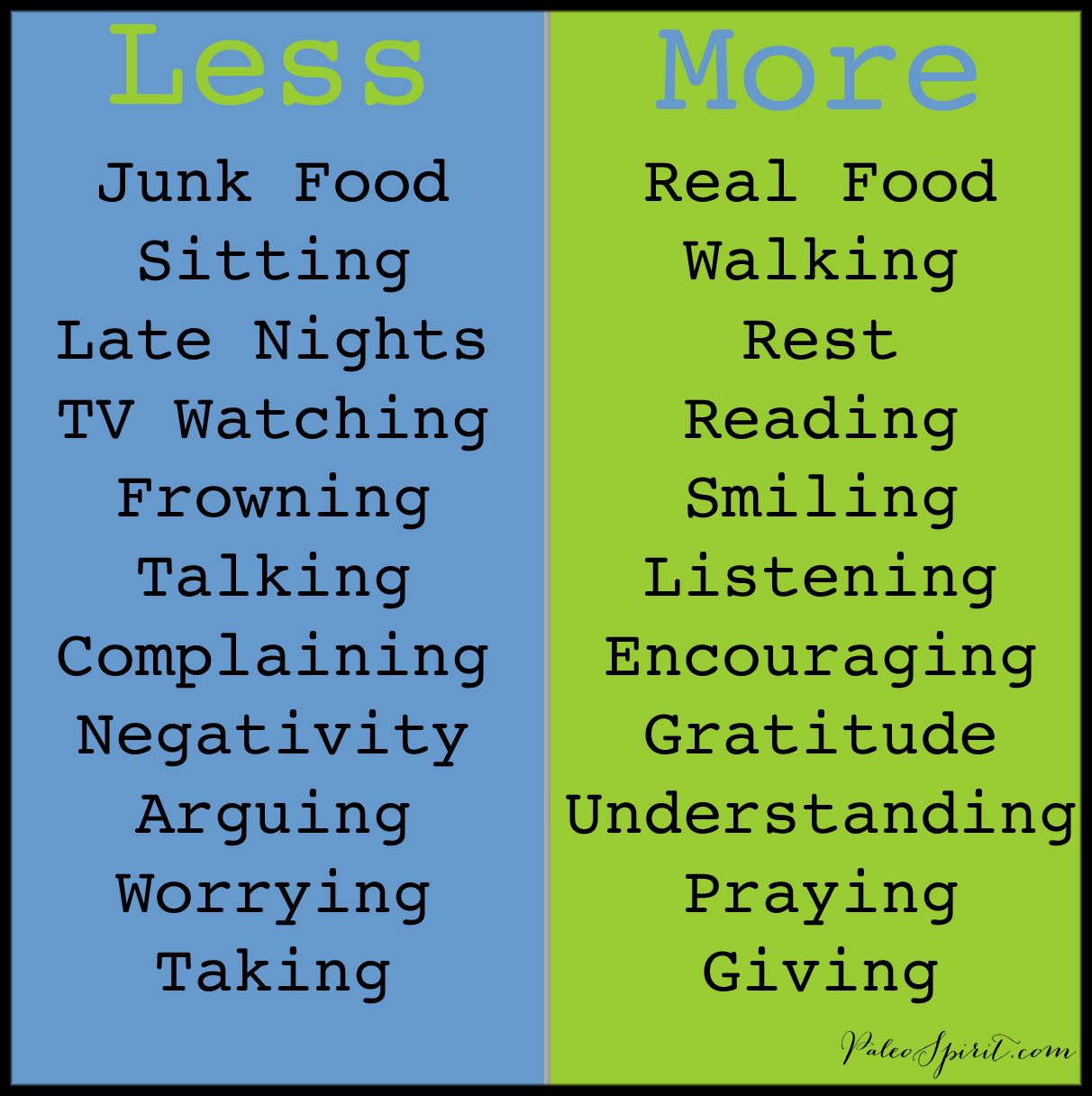
There is so much focus on diet and exercise at the beginning of a new year. Not as much attention is paid to the emotional and spiritual well-being. But there are habits we can cultivate that will help us become more well-rounded individuals, healthy in mind, body, soul and spirit. Today I am sharing the Ten Habits for a Well-Rounded Person (referenced in the Healthy, Happy, and Free post) and which I’ll summarize below:

10 Healthy Habits for Mind, Body, Soul and Spirit

Read more

Paleo Quiche with Spaghetti Squash Crust

paleo quiche with spaghetti squash crust

Weekends around here are super busy now that Lacrosse season is upon us. Tennis is the sport I always envisioned my boys playing. They’ve had some lessons and seem to enjoy it and I will admit to having spent time imagining them as high school tennis stars. Tennis is sensible because it not only works for … Read more

Happy, Healthy and Free

“What we think, we become.”

It was my honor and privilege to be one of the speakers at a Ladies Day event yesterday hosted by the Bridgewater Church of Christ (at Garretson Rd) . The theme of the event was “Do You Know Who I Am?” and my topic was “Happy, Healthy and Free”. This is a subject very near and dear to my heart because I am very passionate about health and fitness for the WHOLE person Mind, Body, Soul and Spirit.

The starting point for my talk was the Bible verse Luke 2:52

Jesus grew in wisdom, and in stature, and in favor with God and Man.

That verse encapsulates the entire 18 year period of Jesus’ growth from age 12 to the beginning of his ministry at the age of 30. It tells us that He grew mentally, physically, spiritually and socially. And I propose that we too need to focus on growing in these areas of our lives in order to be well-rounded individuals. I proposed how, instead of Happy, Healthy and Free, we are often Sick, Stressed and Depressed. This is something with which I am familiar because I have been all three of those things at certain points in my life. I shared some of what I have learned about the Mind-Body connection and how our bodies respond to stress. And lest anyone think that focusing on our own health is somehow self-indulgent, I argued that we NEED to work at our health in order to become more pleasing and useful to God.

What we think, we become. And just as the Lao Tzu quote expresses, our habits become our character which becomes our destiny. With that in mind, and through my own experiences, I have come up with Ten Healthy Habits for the Well-Rounded Person:

Read more

Paleo FX 2012: Movement and Fitness

In addition to lectures and Mastermind panel discussions, the Paleo FX Ancestral Momentum – Theory to Practice Symposium included several movement and fitness sessions. I tried to plan my schedule so I could participate in a few movement sessions without missing too many other things of special interest. Here are some highlights from the main fitness/movements sessions I attended.

MovNat

One of my main goals was to attend a MovNat session. MovNat was founded by Erwan Le Corre who has been proclaimed “one of the fittest men in the world” and a “fitness visionary” by Men’s Health magazine.

Erwan Le Corre via www.movnat.com

MovNat is a physical education and fitness system based entirely on using the full range of our natural, human-specific movements and is aimed at the real-world competency and conditioning that allows optimum physical and mental development.

There are thirteen basic MovNat movement skills:

  1. Lifting
  2. Carrying
  3. Throwing
  4. Catching
  5. Striking
  6. Grappling
  7. Walking
  8. Running
  9. Balancing
  10. Jumping
  11. Crawling
  12. Climbing
  13. Swimming

Here’s a short video that gives some examples of a MovNat workout.

Our instructor Brian led us through some MovNat skill training.

Read more

Healthy, Not Unholy – Part Two

In Part One of “Healthy, Not Unholy” we discussed the benefits and importance of physical fitness. Specifically, that exercise is important for physical and emotional health, how it teaches discipline and can contribute to our confidence. Today, I want to outline the potential downside to making physical fitness an important part of our lives.

To understand how the pursuit of physical fitness and attractiveness can potentially lead one away from God, it  is important to understand the meaning of the word “idolatry.” Idolatry is one of those words that immediately stokes the imagination. It may bring to mind images of ancient civilizations and mystic ceremonies where people dance around large statues and make violent sacrifices to strange and exotic deities.

Ok, ok….sometimes I let my imagination get away from me….but while what I described is accurate, it is not the whole story. According to the dictionary, the primary meaning of idolatry is “the worship of a physical object as a god.” As Christians, we do not acknowledge the existence of any deity but the God of the Bible. Therefore, it is accurate to label the worship of another supposed supernatural being or physical object as idolatry.

And God takes a very dim view of idolatry. In fact, He considers it sinful. We know this because He told us so several times. For example, in the Old Testament book of Exodus, His dislike of idolatry is revealed to Moses as the 1st Commandment:

Exodus 20:2-3

I am The Lord your God, who brought you out of the land of Egypt, out of the house of bondage. You shall have no other gods before Me.

Remember, God gave Moses 10 Commandments, but the very first one describes His view of idolatry! In verse 5 of the same chapter of Exodus, God elaborates further:

Exodus 20:5

5 You shall not bow down to them or worship them; for I, the LORD your God, am a jealous God, punishing the children for the sin of the parents to the third and fourth generation of those who hate me.

Read more

AntiGravity Yoga at Core Connection Studio

vampire pose in antigravity yoga

vampire pose in antigravity yogaOver the past month I have had the wonderful opportunity to experience what is known as AntiGravity Yoga. Prior to a friend telling me about Core Connection Studio I had never heard of AntiGravity Yoga. After visiting their website and seeing photographs and videos of this most unusual practice I knew I wanted to find out more about it.

AntiGravity Yoga (also known as “Aerial Yoga”) is part of an emerging exercise field known as “suspension training”. It was developed by dancer Christopher Harrison (in the 1990s) as a training technique for gymnasts. It was launched to the public in 2007 in New York City. Harrison contracted Lyme disease in 2008 which caused his joints to freeze up and his muscles to atrophy. He used his own techniques in suspension training to get back to health.

The Core Connection Studio website describes it this way:

“AntiGravity Yoga combines traditional yoga principles with elements from aerial acrobatics, dance, Pilates and calisthenics. AntiGravity Yoga helps students realign their body and Spirit with the tool of gravity that serves to achieve physical and mental decompression. You will learn to fly, hold and balance in challenging yoga poses longer, gain better kinesthetic awareness, build cardiovascular and muscular strength, become more flexible, increase joint mobility, decompress the vertebrae of the spine without strain and utilize the agility you’ve gained from yoga to play with gravity! The class emphasis is to have fun while learning new skills while experiencing a total body workout.”

Class begins, like other yoga classes, with meditation, and then transitions to strengthening and stretching activities as well as traditional yoga poses modified for the hammock. You end the class in shavasana while cocooned in the hammock.

One of my favorite things about AntiGravity Yoga is the inversions. Inversions are poses that turn the body upside down to a point where the feet are above the head.

Here’s what an inversion looks like:

antigravity yoga inversion

The above photo is my attempt at “Monkey Pose”. The picture was shot before I got all the way in the pose which would have shown my knees bent and my feet touching. But you get the idea. The first time I got into this pose my initial urge was to tighten up my back and core muscles. But once I felt comfortable I was able to relax the muscles and enjoy the lengthening sensation. Several people have documented an increase in height from doing inversions with the hammock. Even though I have not measured myself, I can attest to the intense stretching and feeling of spinal decompression and alignment. Being wrapped in the hammock ensures your bodyweight is more evenly distributed than if you were using “Anti-Gravity Boots” or something similar. This means the inversions are very comfortable. The AntiGravity class also provides what can only be described as the equivalent of a deep-tissue massage in certain poses when the hammock is tight across the hip flexors.

Here are a couple more examples of inversions.

Read more